
Graz University of Technology researchers develop microbial façades that protect, repair surfaces, and filter air pollutants.
From Graz University of Technology 26/05/25 (first released 21/05/25)
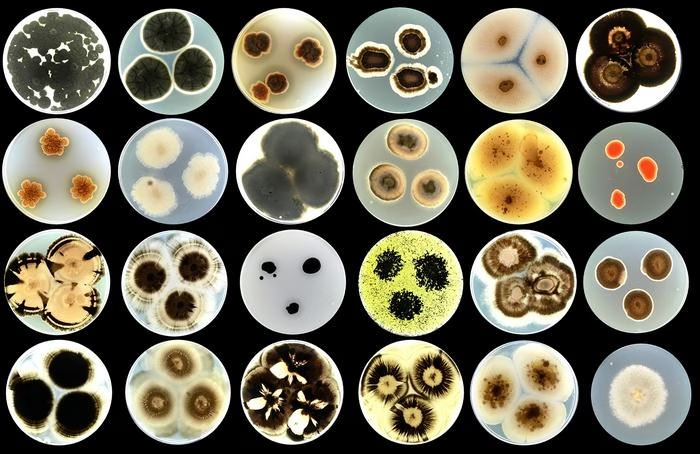
External walls of buildings are normally lifeless and have no additional function.
An international team of researchers and companies, in which Carole Planchette from the Institute of Fluid Mechanics and Heat Transfer is involved, wants to change this by adding microbial life to building façades.
In the project “Archibiome tattoo for resistant, responsive, and resilient cities” (REMEDY), the consortium is working on integrating specifically composed communities of beneficial microorganisms into living ink that adheres to exterior walls made of concrete, wood, metal and other building materials.
These living tattoos on buildings are intended to protect the façades from weathering, store CO2 and filter pollutants from the air. The European Innovation Council is funding the four-year project with a total of almost three million euros as part of the Pathfinder funding programme.
Billions of square metres of potential wall space
Over the next 25 years, building façades and roofs with a total area of 9.4 billion square metres will be renovated or newly built in the European Union.
“This is a huge potential that we should utilise.
Microbiological communities on roofs and façades could fulfil numerous functions without taking up scarce, undeveloped space,” says Carole Planchette.
Useful microbiome for buildings
At the University of Ljubljana, a team led by microbiologist Nina Gunde-Cimerman is looking for suitable microorganisms.
The researchers want to design interkingdom microbial consortia that form stable communities.
”The aim is to create a beneficial microbiome for buildings that is resistant to pathogenic microbes and repairs superficial cracks on its own,” says Carole Planchette.
“Additional benefits will range from carbon sequestration and oxygen production to bioremediation, among others.”
At the Institute of Fluid Mechanics and Heat Transfer, Carole Planchette is responsible for developing a suitable, printable ink in which the microorganisms can survive.
“We opted for inkjet printing because it allows us to apply the living ink very precisely, in a controlled manner and quickly at the same time,” explains Carole Planchette.
The dimensions of the microorganisms, which reach the size of several micrometres and are expected to aggregate in millimetric clusters, are a challenge: They are too bulky for conventional inkjet technology, in which usually particles in the nanometre range are sprayed.
Together with the Slovak inkjet manufacturer Qres Technologies and the Austrian coating specialist Tiger Coatings, Carole Planchette is working on the necessary technological modifications.
Technology breakthrough
“The ambition of REMEDY is to achieve a breakthrough in fundamental research in microbiology and synthetic biology, transfer the know-how to materials science in the form of engineered living materials, and develop compatible biofabrication processes that allow personalised design in the architectural context,” says project coordinator Anna Sandak from the research institute InnoRenew CoE in Izola, Slovenia.
”I am confident that we will develop suitable inks and the customised inkjet technology within the project duration,” says Carole Planchette.
“I also expect that we will find suitable microorganisms that survive in the ink and under the stress generated by printing.
It will be interesting to see whether we succeed in making this process already fully reproducible over the next four years.
Using living – thus evolving – inks for industrial processes such as inkjet printing, which tolerate little parameter variations, is a challenge, as we are entering uncharted territory with the REMEDY project.”
The consortium brings together six partners from four EU countries: Slovenia, Austria, the Netherlands, and Slovakia.
The collaboration includes InnoRenew CoE acting as coordinator, University of Ljubljana, Graz University of Technology, TIGER Coatings, Xylotrade B.V., and Qres Technologies, with the in-kind support of the University of Primorska as a third party.
You may also be curious about:
-

‘Space archaeology’ reveals first dynamic history of a giant spiral galaxy
-

Thousands of pico-satellites may transform how phones connect to space
-

Barcelona’s Low Emission Zone reduces NO₂ levels
-
Neuroadaptive VR treatment for arachnophobia
-
The freshwater hidden beneath the Great Salt Lake
-
Moby Dick ‘ship sinking’ sperm whales caught headbutting on camera
-
Changing shower and toilet habits could help close England’s 5 billion litre water gap, Surrey-led research finds
-

Is your brain aging faster than you are? Sleep may hold the key
-
Initial tests find lead in children’s fast-fashion clothing
-
Aquatic plant reduces antibiotics in water and genetic damage in fish
-

When the Earth moved
-
Turning sawdust into fire-resistant, eco-friendly materials using watermelon seeds