
Researchers at South China University of Technology (SCUT) University developed an amphibious robotic dog featuring unique paddling mechanisms inspired by canine swimming.
From IOP Publishing 09/05/25 (first released 08/05/25)
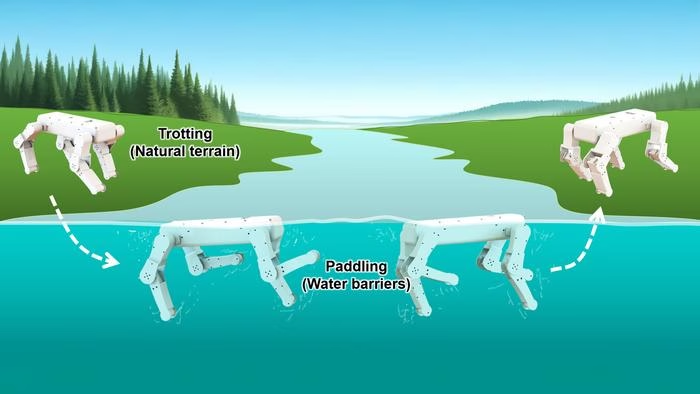
A team of researchers has unveiled a cutting-edge Amphibious Robotic Dog capable of roving across both land and water with remarkable efficiency.
The study, published in IOP Publishing’s Bioinspiration and Biometrics, was inspired by mammals’ ability to move through water as well as on land.
Existing amphibious robots are largely inspired by reptiles or insects, and often face limitations in agility, dynamics, and load capacity.
Basing the amphibious robot on the swimming style of dogs allows for it to easily transition between land and water and overcome many of the challenges faced by insect-inspired designs.
The amphibious robot paves the way for future applications in environmental research, military vehicles, rescue missions, and beyond.
To enhance its water mobility, the amphibious robotic dog features a unique paddling mechanism, modelled after the swimming motion of dogs.
Careful engineering of its structure, including precise weight and buoyancy balance, ensures stable and effective aquatic performance.
The team developed and tested three distinct paddling gaits:
Through extensive experimentation, the doggy paddle method proved superior for speed, achieving a maximum water speed of 0.576 kilometres per hour (kph), while the trot-like style prioritised stability.
On land, the amphibious robotic dog reaches speeds of 1.26 kph, offering versatile mobility in amphibious environments.
“This innovation marks a big step forward in designing nature-inspired robots,” says Yunquan Li, corresponding author of the study.
“Our robot dog’s ability to efficiently move through water and on land is due to its bioinspired trajectory planning, which mimics the natural paddling gait of real dogs.
The double-joint leg structure and three different paddling gaits address previous limitations such as slow swimming speeds and unrealistic gait planning, making the robotic dog much more effective in water.”
More info
You may also be curious about:
-

‘Space archaeology’ reveals first dynamic history of a giant spiral galaxy
-
Thousands of pico-satellites may transform how phones connect to space
-

Barcelona’s Low Emission Zone reduces NO₂ levels
-
Neuroadaptive VR treatment for arachnophobia
-
The freshwater hidden beneath the Great Salt Lake
-
Moby Dick ‘ship sinking’ sperm whales caught headbutting on camera
-

Changing shower and toilet habits could help close England’s 5 billion litre water gap, Surrey-led research finds
-

Is your brain aging faster than you are? Sleep may hold the key
-

Initial tests find lead in children’s fast-fashion clothing
-
Aquatic plant reduces antibiotics in water and genetic damage in fish
-

When the Earth moved
-

Turning sawdust into fire-resistant, eco-friendly materials using watermelon seeds
0rcdl8
avaqvj