
University of Texas at Austin researchers achieve milestone by growing chickpeas in simulated lunar soil with vermicompost.
From University of Texas at Austin 06/03/26 (first released 05/03/26)
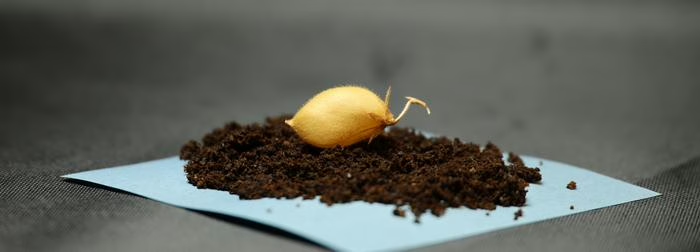
As the U.S. plans to return to the moon with the upcoming Artemis II mission, a question endures: What will future lunar explorers eat?
According to new research from The University of Texas at Austin the answer might be chickpeas.
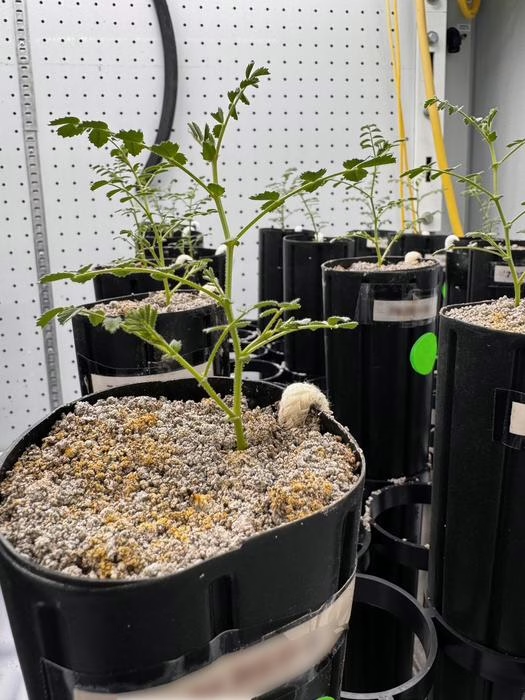
Scientists have successfully grown and harvested chickpeas using simulated “moon dirt,” the first instance of this crop produced in this medium.
The research, which was conducted in collaboration with Texas A&M University, is described in a paper published in the journal Scientific Reports.
Sara Santos, the principal investigator of the project, said that the work is a giant leap in understanding what it will take to grow food on the lunar surface.
“The research is about understanding the viability of growing crops on the moon,” said Santos, who is a distinguished postdoctoral fellow at the University of Texas Institute for Geophysics (UTIG) at the Jackson School of Geosciences.
“How do we transform this regolith into soil?
What kinds of natural mechanisms can cause this conversion?”
Lunar regolith is the technical term for moon dirt.
It lacks the microorganisms and organic material required for plants to live, and while it contains essential nutrients and minerals for plants to grow, it also contains heavy metals that could be toxic to plants.
For their study, the researchers used simulated moon dirt from Exolith Labs, a mix that models the composition of lunar samples brought back by Apollo astronauts.
To create ideal growing conditions in the moon dirt, the team added vermicompost, a byproduct of red wiggler earthworms that’s rich in essential plant nutrients and minerals and has a diverse microbiome.
The earthworms create this product by consuming organic material like food scraps or cotton-based clothes and hygiene products that would be otherwise thrown away on missions.
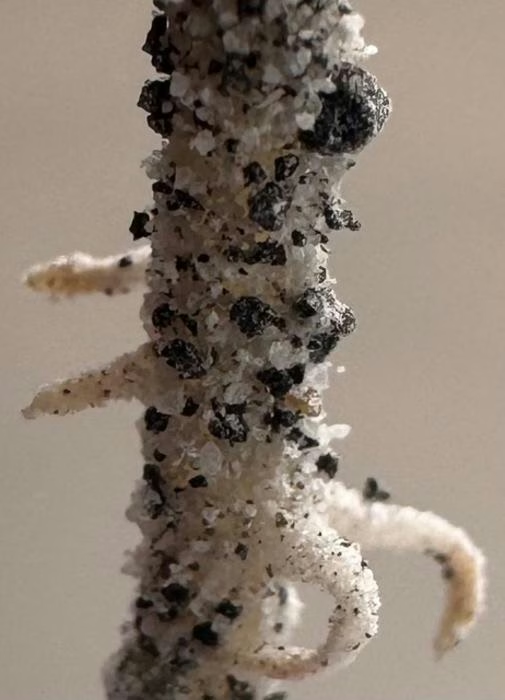
The team then coated the chickpeas with the fungi arbuscular mycorrhizae before planting.
The fungi and chickpeas work symbiotically, with the fungi taking up some essential nutrients needed for growth while reducing the uptake of heavy metals.
After that, Santos’ team planted the chickpeas in a mixture of moon dirt and vermicompost in varying proportions.
They found that mixtures of up to 75% moon dirt successfully produced harvestable chickpeas.
However, any higher percentage of moon dirt caused issues, with the plants showing signs of stress and early death.
The stressed plants survived longer than chickpeas that weren’t inoculated with fungi, showing the importance of their importance to plant health.
What’s more, the researchers found that the fungi were able to colonize and survive in the simulant, suggesting they would only need to be introduced one time in a real-world growing setting.
Although harvesting the chickpeas is a big milestone, how the legumes taste and safety is still an open question.
The researchers still need to determine the nutritional content of the chickpea and ensure toxic metals were not absorbed during the growing process.
“We want to understand their feasibility as a food source,” said Jessica Atkin, the first author on the paper and a doctoral candidate in the Department of Soil and Crop Sciences at Texas A&M University.
“How healthy are they?
Do they have the nutrients astronauts need?
If they aren’t safe to eat, how many generations until they are?”
While this research was initially funded by Santos and Atkin, the project has now been funded by a NASA FINESST grant.
More info
You may also be curious about:
-

‘Space archaeology’ reveals first dynamic history of a giant spiral galaxy
-
Thousands of pico-satellites may transform how phones connect to space
-

Barcelona’s Low Emission Zone reduces NO₂ levels
-
Neuroadaptive VR treatment for arachnophobia
-
The freshwater hidden beneath the Great Salt Lake
-
Moby Dick ‘ship sinking’ sperm whales caught headbutting on camera
-
Changing shower and toilet habits could help close England’s 5 billion litre water gap, Surrey-led research finds
-

Is your brain aging faster than you are? Sleep may hold the key
-
Initial tests find lead in children’s fast-fashion clothing
-
Aquatic plant reduces antibiotics in water and genetic damage in fish
-

When the Earth moved
-

Turning sawdust into fire-resistant, eco-friendly materials using watermelon seeds