
Researchers at the Chinese Academy of Sciences use innovative fibre-optic technology to monitor soil water dynamics.
From Chinese Academy of Sciences Headquarters 23/03/26 (first released 19/03/26)
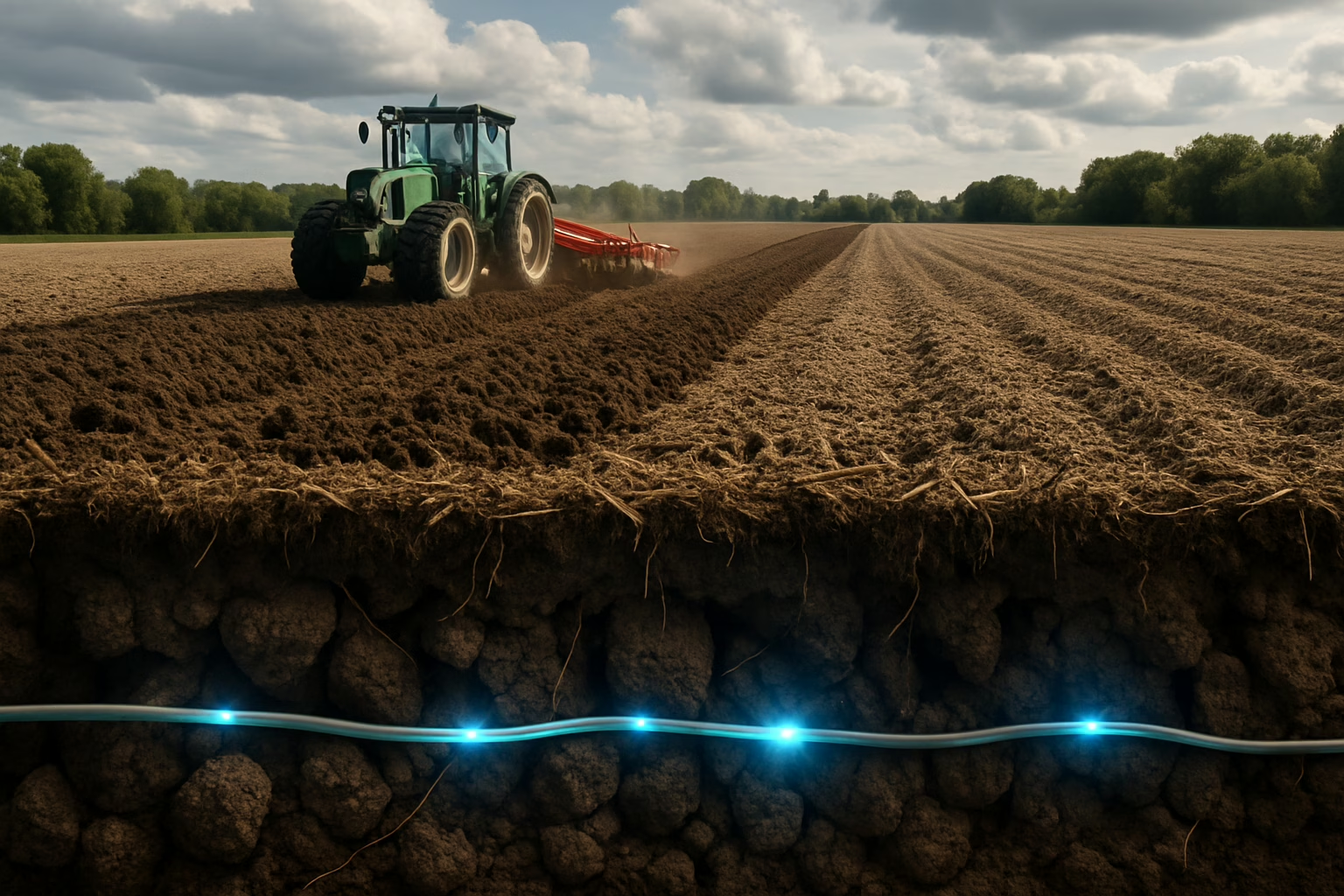
Soil is often perceived simply as “dirt,” but in reality, it is a dynamic, living system that acts as the Earth’s natural sponge.
Unfortunately, common agricultural practices—including deep plowing and the use of heavy machinery—can severely disrupt this natural system, according to a new study led by Dr. SHI Qibin from the Institute of Geology and Geophysics of the Chinese Academy of Sciences, in collaboration with international partners.
The study, published in Science on March 19, shows that healthy soil contains a natural internal “plumbing” network of microscopic pores and channels that allow water to infiltrate deeply into the ground, where it becomes available to plant roots.
Frequent plowing or heavy tractor traffic not only disrupts soil structure but also reduces its ability to help crops withstand both flooding and drought.
The team used a novel technique to observe subsurface soil processes without excavation.
The researchers converted standard fiber-optic cables—similar to those used in high-speed internet networks—into a large-scale sensor array installed across an experimental farm at Harper Adams University in the United Kingdom.
By using the array to detect tiny ground vibrations generated by water flow, the researchers were able to monitor water movement through the soil minute by minute.
Using high-resolution fiber-optic data, they observed that rainfall tends to pool near the surface in heavily cultivated soil.
Because water remains shallow, it evaporates rapidly in sunlight, leaving deeper soil layers dry. By contrast, undisturbed soils act as efficient natural filters, quickly absorbing water and storing it in deeper layers where plants can access it during dry periods.
To explain these observations, the research team developed a dynamic capillary stress model that assumes an “ink-bottle effect” within soil pore structures.
In other words, water flows into a pore (bottle) with ease, but flows out with more difficulty.
These differences are attributable to capillary forces that hold soil together more or less strongly, depending on whether the soil is drying or wetting—even when overall moisture content remains the same.
This model is much more complex than traditional soil mechanics, which generally assumes that soil strength depends primarily on total water content.
“Rather than a simple collection of particles, soil is a porous medium in which the structure functions like capillary vessels within the water cycle,” Dr. SHI explained.
The findings underscore the need to rethink agricultural land management.
Excessive tillage and soil compaction caused by heavy machinery do not merely rearrange soil particles; they break the invisible mechanical bonds that allow soil to breathe, circulate water, and maintain ecological stability.
Preserving these natural structures will be critical to helping crops adapt to increasingly extreme weather conditions driven by climate change, the researchers explained.
The study is noteworthy for introducing distributed fiber-optic sensing—and the larger field of agroseismology—to assess the health of soil water systems without physically disturbing the land.
By “listening” to the Earth in this way, scientists and farmers will be able to “diagnose” agricultural soil conditions in real time and develop more resilient strategies for sustainable food production.
More info
You may also be curious about:
-

‘Space archaeology’ reveals first dynamic history of a giant spiral galaxy
-
Thousands of pico-satellites may transform how phones connect to space
-

Barcelona’s Low Emission Zone reduces NO₂ levels
-
Neuroadaptive VR treatment for arachnophobia
-
The freshwater hidden beneath the Great Salt Lake
-

Moby Dick ‘ship sinking’ sperm whales caught headbutting on camera
-

Changing shower and toilet habits could help close England’s 5 billion litre water gap, Surrey-led research finds
-

Is your brain aging faster than you are? Sleep may hold the key
-
Initial tests find lead in children’s fast-fashion clothing
-
Aquatic plant reduces antibiotics in water and genetic damage in fish
-

When the Earth moved
-
Turning sawdust into fire-resistant, eco-friendly materials using watermelon seeds