
University of Maryland scientists capture unprecedented atomic-scale thermal vibrations, unveiling hidden dynamics in two-dimensional quantum materials.
From University of Maryland 28/07/25 (first released 24/07/25)

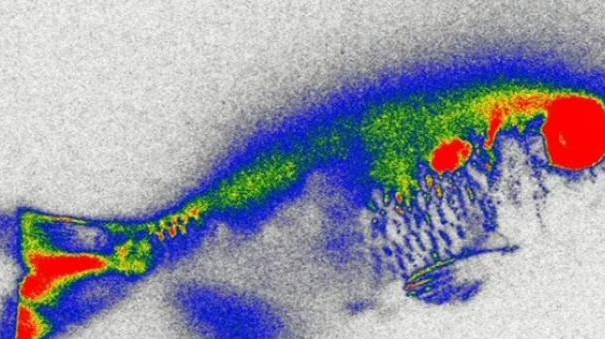
College Park, Md. — Researchers investigating atomic-scale phenomena impacting next-generation electronic and quantum devices have captured the first microscopy images of atomic thermal vibrations, revealing a new type of motion that could reshape the design of quantum technologies and ultrathin electronics.
Yichao Zhang, an assistant professor in the University of Maryland Department of Materials Science and Engineering, has developed an electron microscopy technique to directly image “moiré phasons”—a physical phenomenon that impacts superconductivity and heat conduction in two-dimensional materials for next-generation electronic and quantum devices.
A paper about the research, which documents images of the thermal vibration of individual atoms for the first time, published July 24 in the journal Science.
Two-dimensional materials, which are sheet-like structures a few nanometers thick, are being explored as new components of next-generation quantum and electronic devices.
A feature in twisted two-dimensional materials are “moiré phasons,” critical to understanding the materials’ thermal conductivity, electronic behavior, and structural order.
Previously, moiré phasons were difficult to detect experimentally, preventing further understanding of the materials that could revolutionize quantum technologies and energy-efficient electronics.
Zhang’s research team took on this challenge by using a new technique called “electron ptychography,” which achieved the highest resolution documented (better than 15 picometer) and detected blurring of individual atoms caused by thermal vibrations.
Her work has revealed that spatially localized moiré phasons dominate thermal vibrations of twisted two-dimensional materials, which fundamentally reshaped how scientists understand its impact.
The breakthrough study, which confirmed the longstanding theoretical predictions of moiré phasons, also demonstrated that “electron ptychography” can be used to map thermal vibrations with atomic precision for the first time—which was previously an experimental capability out of reach.
“This is like decoding a hidden language of atomic motion,” said Zhang.
“Electron ptychography lets us see these subtle vibrations directly.
Now we have a powerful new method to explore previously hidden physics, which will accelerate discoveries in two dimensional quantum materials.”
Zhang’s research team will next focus on resolving how thermal vibrations are affected by defects and interfaces in quantum and electronic materials.
Controlling the thermal vibration behavior of these materials could enable the design of novel devices with tailored thermal, electronic, and optical properties—paving the way for advances in quantum computing, energy-efficient electronics, and nanoscale sensors.
More info
You may also be curious about:
-

‘Space archaeology’ reveals first dynamic history of a giant spiral galaxy
-

Thousands of pico-satellites may transform how phones connect to space
-

Barcelona’s Low Emission Zone reduces NO₂ levels
-

Neuroadaptive VR treatment for arachnophobia
-

The freshwater hidden beneath the Great Salt Lake
-

Moby Dick ‘ship sinking’ sperm whales caught headbutting on camera
-

Changing shower and toilet habits could help close England’s 5 billion litre water gap, Surrey-led research finds
-

Is your brain aging faster than you are? Sleep may hold the key
-

Initial tests find lead in children’s fast-fashion clothing
-
Aquatic plant reduces antibiotics in water and genetic damage in fish
-

When the Earth moved
-

Turning sawdust into fire-resistant, eco-friendly materials using watermelon seeds