
Thousands of pico-satellites may transform how phones connect to space
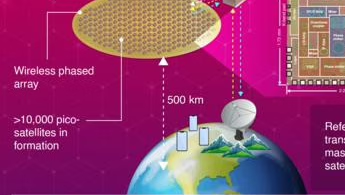
Researchers at Science Tokyo innovate wireless synchronisation for cost-effective, reliable direct-to-smartphone satellite communications globally.
EyeDAR: Roadside radar sensors could reduce blind spots for self-driving cars
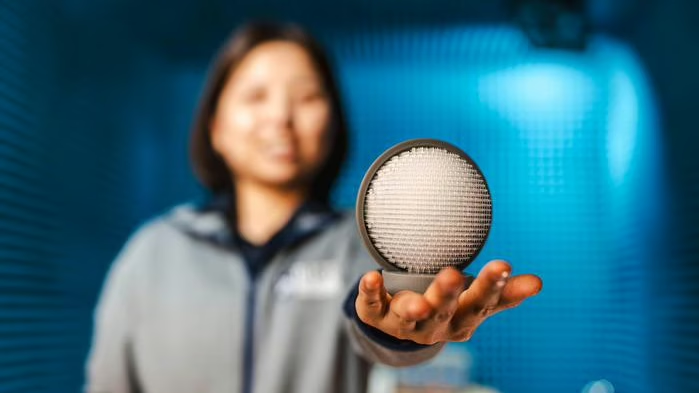
Rice University develops EyeDAR, a compact, low-power radar sensor enhancing AVs’ perception in challenging visibility conditions.
Top AI coding tools make mistakes one in four times

University of Waterloo research reveals AI’s 75% accuracy in structured outputs, highlighting need for human oversight.
Improving AI models’ ability to explain their predictions

MIT researchers develop a method enhancing AI transparency, using human-understandable concepts for better prediction accuracy.
UMD entomologist helps bring the world’s ant diversity to life in 3D imagery

University of Maryland researchers utilise AI and robotics to rapidly create detailed 3D models of ant species.
How can you rescue a “kidnapped” robot?

Researchers at Miguel Hernández University of Elche develop a LiDAR-based system to tackle robot disorientation challenges.
AI model can read and diagnose a brain MRI in seconds

University of Michigan’s AI model achieves 97.5% accuracy, potentially transforming neuroimaging and easing physician workload.
AI learns better when it talks to itself

Researchers at Okinawa Institute of Science and Technology find self-talk enhances AI multitasking and task generalisation abilities.
Sculpting complex, 3D nanostructures with a focused ion beam

Researchers at RIKEN and collaborators develop innovative method to craft switchable diodes from topological magnets.
Creative talent: has AI knocked humans out?

Université de Montréal study reveals AI surpasses average human creativity, yet top human creators still excel.