
Researchers document first images of the atomic fingerprint of heat in quantum materials

University of Maryland scientists capture unprecedented atomic-scale thermal vibrations, unveiling hidden dynamics in two-dimensional quantum materials.
Artificial intelligence identifies anti-aging drug candidates targeting ‘zombie’ cells

Researchers from MIT and Integrated Biosciences discover three potent senolytic compounds with high oral bioavailability.
Brains over bots: Why toddlers still beat AI at learning language

Researchers at the Max Planck Institute reveal toddlers’ interactive learning process surpasses AI’s passive data absorption.
Boson sampling finds first practical applications in quantum AI

Okinawa Institute of Science and Technology pioneers energy-efficient quantum machine learning, achieving higher accuracy in image recognition.
Smart amplifier enabler for more qubits in future quantum computers

Chalmers University of Technology develops energy-efficient amplifier, reducing power consumption by 90% to enhance qubit performance.
International study: AI has little impact on workers’ wellbeing so far, but…

University of Pittsburgh researchers find AI exposure may improve physical health, yet caution against drawing early conclusions.
Virtual reality could help stroke survivors regain movement

Flinders University researchers find VR therapy increases rehabilitation time, slightly improving arm function and balance for stroke survivors.
Message in a bubble: Using physics to encode messages in ice

Researchers at the Beijing Institute of Technology develop a novel method to store covert messages in icy regions.
How the world is preparing the workforce for AI
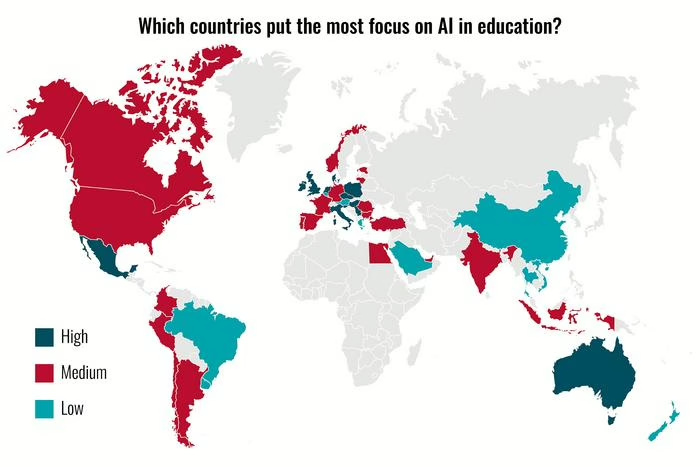
University of Georgia research highlights global strategies prioritising AI education, with European countries leading the efforts.
AI paves the way towards green cement
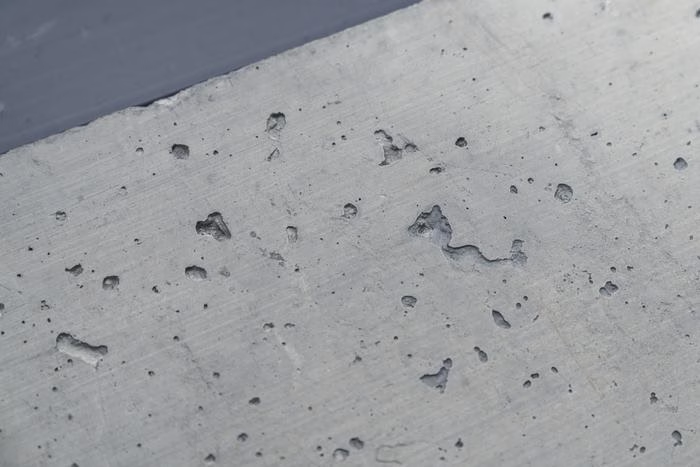
Researchers at Paul Scherrer Institute develop AI model reducing cement emissions by optimising formulations for sustainability.