
Peking University develops versatile suction disc, maintaining grip underwater and in air, inspired by lamprey anatomy.
From Beijing Institute of Technology Press Co., Ltd 13/03/26 (first released 10/03/26)
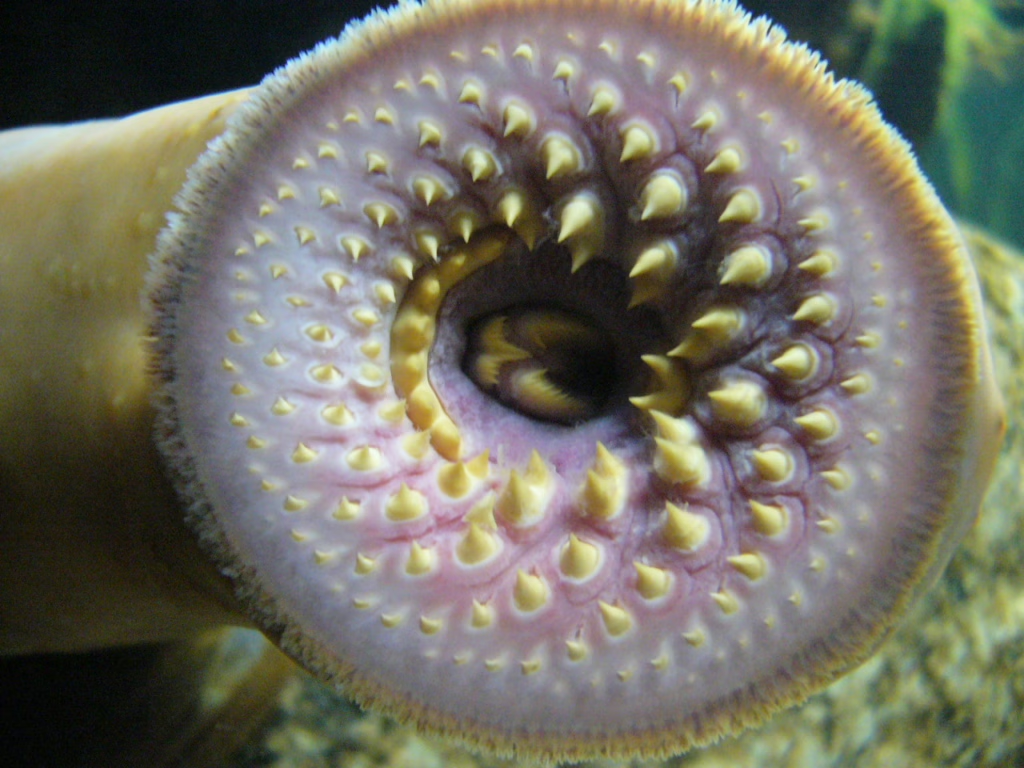
“In complex cross-media environments, existing attachment mechanisms face significant physical constraints,” said Junzhi Yu, corresponding author and Professor at Peking University.
“Traditional suction cups easily fail underwater due to fluid washing, or they lose their vacuum seal on rough surfaces.
We needed a unified mechanism that could break through the dual barriers of environmental media and surface morphology.”
To achieve this, the team looked to the lamprey.
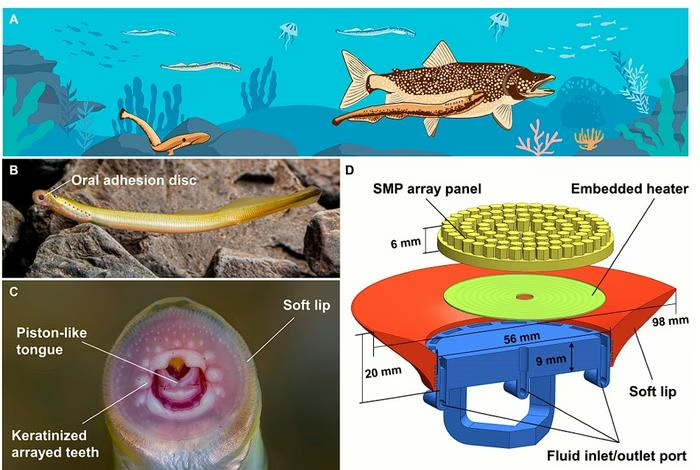
The ancient fish uses a soft lip to create a seal, a muscle pump to generate a vacuum, and a ring of horny teeth to physically interlock with a rough surface.
Replicating this biological masterpiece, the researchers designed a robotic suction disc that integrates a flexible silicone lip with a smart core made of a temperature-controlled Shape Memory Polymer (SMP).
The science behind it is both elegant and highly effective.
When the built-in heater warms the SMP to just above 33 °C, the material softens into a rubbery state.
As the vacuum activates, this softened material is sucked deep into the microscopic crevices and pores of the target surface, perfectly imprinting its texture.
Once the heat is turned off, the SMP rapidly cools and hardens back into a rigid state, essentially locking itself into the surface like a custom-made key in a lock.
“This hybrid mechanism successfully decouples adhesion strength from continuous vacuum maintenance,” Yu explained.
“Even if the external vacuum system fails, or if there is slight air leakage on extremely rough surfaces, the physical interlocking of the hardened SMP allows the device to maintain a highly secure grip for an ultra-long time.”
In laboratory tests, the results were striking.
The compact device, weighing only 70 grams, generated enough pull-off force to stably lift heavy loads exceeding 850 times its own weight in both air and water.
On highly rough surfaces where traditional pure-vacuum suction cups failed completely, the bio-inspired disc maintained its grip.
Its effective adhesion time in the air was nearly tripled, while underwater retention time increased by up to 540%.
But the suction disc’s capabilities extend far beyond just lifting heavy weights; its true power lies in its extreme versatility across different scales and shapes.
In dry tests, the device demonstrated an astonishing operational span, safely handling objects spanning six orders of magnitude in mass—from delicately picking up a fragile 0.01-gram microelectronic chip to robustly carrying an 11.4-kilogram desk.
It seamlessly adapted to irregular everyday items and complex industrial tools like wrenches and hammers.
Underwater, the system proved equally adaptable.
It firmly gripped not only smooth metal coins but also highly irregular, naturally porous objects like red bricks, scallop shells, and large conches with complex three-dimensional curves.
To prove the system’s real-world versatility, the team conducted a highly challenging cross-media demonstration.
A robotic arm equipped with the suction cup precisely grabbed a bionic manta ray robot in the air, submerged it entirely into a water tank, let it swim, and then successfully re-attached to the wet robot underwater to lift it back into the air.
“The system adapted flawlessly to the air-water interface transition,” said the researchers.
“The application scenarios for this technology are vast.
We envision this technology being deeply integrated into various robotic platforms, playing a crucial role in deep-sea resource exploration, marine engineering maintenance, and amphibious emergency rescue operations.”
Co-first authors of the paper are associate research fellow Lei Li and master student Wenzhuo Gao from the School of Advanced Manufacturing and Robotics at Peking University.
Other contributors include Boyang Qin, Bo Wang, and Shihan Kong from the School of Advanced Manufacturing and Robotics, Peking University; Yiyuan Zhang, College of Design and Engineering, National University of Singapore; Changhong Linghu, City University of Hong Kong; and Yitian Ma, School of Mechatronical Engineering, Beijing Institute of Technology.
The National Natural Science Foundation of China, the Beijing Nova Program, the Natural Science Foundation of Hebei Province, the National Postdoctoral Fellowship Program, and the China Postdoctoral Science Foundation supported this work.
More info
You may also be curious about:
-

‘Space archaeology’ reveals first dynamic history of a giant spiral galaxy
-
Thousands of pico-satellites may transform how phones connect to space
-

Barcelona’s Low Emission Zone reduces NO₂ levels
-
Neuroadaptive VR treatment for arachnophobia
-
The freshwater hidden beneath the Great Salt Lake
-
Moby Dick ‘ship sinking’ sperm whales caught headbutting on camera
-

Changing shower and toilet habits could help close England’s 5 billion litre water gap, Surrey-led research finds
-

Is your brain aging faster than you are? Sleep may hold the key
-
Initial tests find lead in children’s fast-fashion clothing
-
Aquatic plant reduces antibiotics in water and genetic damage in fish
-

When the Earth moved
-
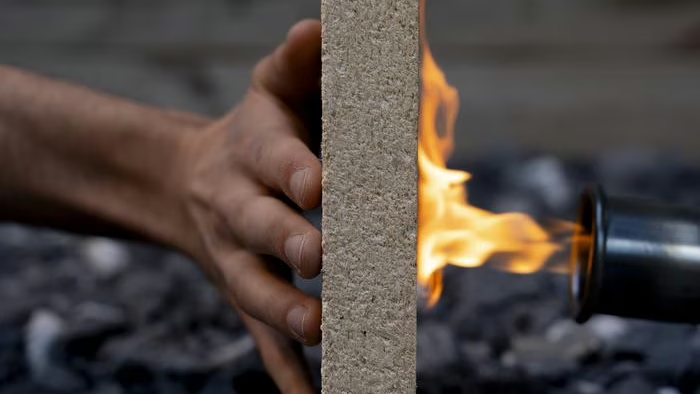
Turning sawdust into fire-resistant, eco-friendly materials using watermelon seeds