
Polytechnic University of Valencia scientists have halved the time it takes to break up kidney stones in ex vivo tests.
From Polytechnic University of Valencia 19/03/25 (first released 11/03/25)
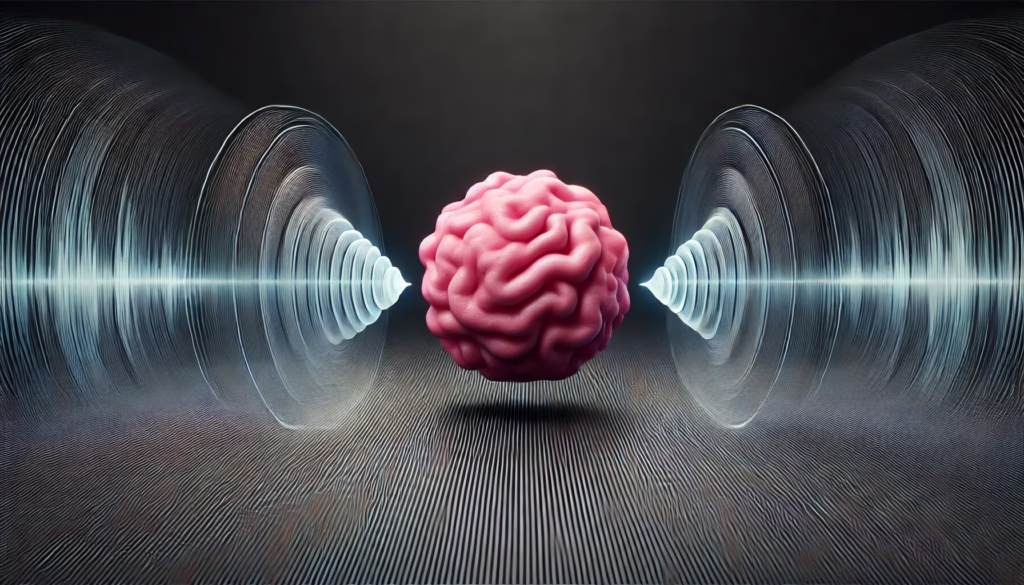
A team from the Universitat Politècnica de València (UPV) and the Spanish National Research Council (CSIC), belonging to the Research Institute for Molecular Imaging Technologies (I3M), has developed, together with the NITIUV Group of the La Fe Health Research Institute (IIS La Fe) in Valencia and the Biomechanics Institute of Valencia, a new device – in the prototype phase – to break up kidney stones.
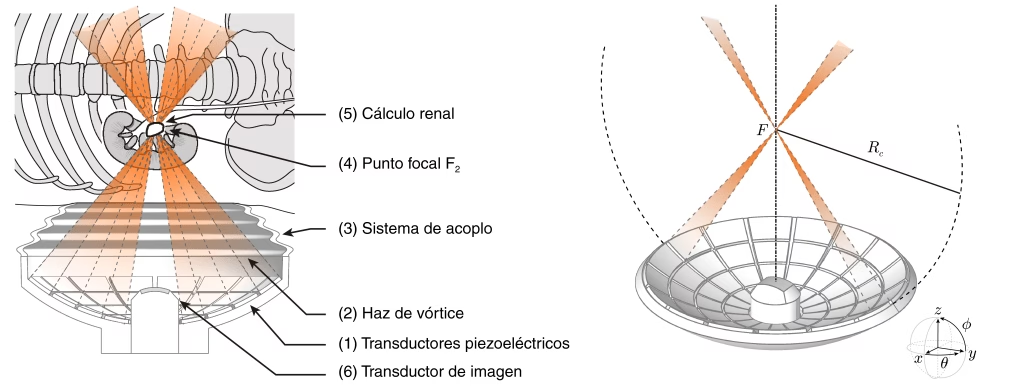
Lithovortex is a low-cost, portable device capable of destroying stones non-invasively, thanks to the application of ultrasound – it transmits waves from the outside to focus them inside the body, on the stone.
According to the tests, its application halves the time needed to break up a stone.
In addition, the size and portability of this device would make the treatment of kidney stones an outpatient procedure without the need for large accessory equipment, as is currently the case.
A microscopic ‘pinch’ on the stone
As Noé Jiménez, a researcher at the I3M Institute (UPV-CSIC), explains, Lithovortex acts based on a new type of acoustic wave, vortex beams.
“We could draw an analogy with a sound whirlpool, where the wave curls and spins on itself when it focuses on the stone.”
“These beams can produce shear forces on kidney stones more efficiently than a conventional beam.”
“It is as if they were to give a microscopic pinch inside the stone, and that pinch causes the stone to fragment into very fine pieces, breaking down into sand that is finally expelled through the urethra,” explains Noé Jiménez.
The device incorporates a therapeutic head of high-intensity acoustic vortices mounted on an automated robotic arm and an imaging system to guide the treatment.
“The advantage of using this type of beam is that, as they are so efficient, they allow the amplitude of the wave to be halved, and this also reduces the likelihood of producing lesions and pain in healthy tissue.”
adds Dr César David Vera Donoso, from the Urology Department at La Fe Hospital and head of the Integrated Translational Urological Research Centre of Valencia (NITIUV) at the IIS La Fe in Valencia, which carried out the initial study.
The main application is the fragmentation of kidney stones.
Still, in the same way that it fragments these stones, it could fragment other important calcifications, such as, for example, calcification of the aortic valve.
To date, the I3M (UPV-CSIC) team has manufactured and validated the device with artificial stones.
In collaboration with the Lithotripsy Unit of the La Fe Hospital in Valencia, the prototype has been validated ex vivo with real stones.
Next year it will be validated in an animal model.
More info
You may also be curious about:
-

‘Space archaeology’ reveals first dynamic history of a giant spiral galaxy
-
Thousands of pico-satellites may transform how phones connect to space
-

Barcelona’s Low Emission Zone reduces NO₂ levels
-
Neuroadaptive VR treatment for arachnophobia
-
The freshwater hidden beneath the Great Salt Lake
-
Moby Dick ‘ship sinking’ sperm whales caught headbutting on camera
-

Changing shower and toilet habits could help close England’s 5 billion litre water gap, Surrey-led research finds
-

Is your brain aging faster than you are? Sleep may hold the key
-
Initial tests find lead in children’s fast-fashion clothing
-
Aquatic plant reduces antibiotics in water and genetic damage in fish
-

When the Earth moved
-
Turning sawdust into fire-resistant, eco-friendly materials using watermelon seeds
gvfyb9