
5 min brisk walk could boost brain power

University of South Australia study reveals even five minutes of exercise daily enhances cognitive function in seniors.
Could a mini-stroke leave lasting fatigue?

Aalborg University research reveals mini-stroke survivors may experience fatigue for up to a year post-incident.
Energy and memory: A new neural network paradigm

Researchers at UC Santa Barbara explore dynamic energy landscapes to enhance memory retrieval in artificial neural networks.
Long working hours may alter brain structure, preliminary findings suggest

Researchers at Gachon University find overworking healthcare professionals may face changes in emotional regulation brain areas.
Brain scans reveal what happens in the mind when insight strikes

Duke University researchers discover that “aha!” moments enhance memory retention, reshaping brain information representation during problem-solving.
By 15 months, infants learn new words for objects they’ve never seen

Researchers from Northwestern University discovered infants can infer meanings from context, forming mental representations of unseen objects.
Increasing exercise in middle age may protect against Alzheimer’s disease

Researchers at the Barcelona Institute for Global Health find Meeting find physical activity associated with lower accumulation of beta-amyloid, a protein linked to Alzheimer’s disease.
Too fast to see: Rapid eye movements predict speed limits in perception

Researchers at TU Berlin discover eye movement speed limits perception, revealing why fast-moving objects become invisible.
New pipette can activate individual neurons

Researchers at Linköping University develop a pipette delivering ions to neurons, potentially treating epilepsy precisely.
The future of brain activity monitoring may look like a single strand of hair
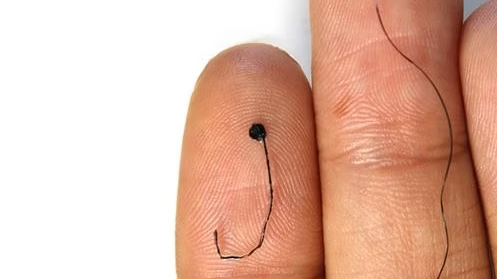
Researchers at Penn State develop a lightweight, flexible electrode for long-term, inconspicuous EEG monitoring on the scalp.