
Kobe University develops a groundbreaking camera that records 3D holograms through tissues, using high-speed micromirrors.
From Kobe University 21/05/25 (first released 21/05/25)

A new camera setup can record three-dimensional movies with a single pixel.
Moreover, the technique can obtain images outside the visible spectrum and even through tissues.
The Kobe University development thus opens the door to holographic video microscopy.
Holograms are not only used as fun-to-look-at safety stickers on credit cards, electronic products or banknotes; they have scientific applications in sensors and in microscopy as well.
Traditionally, holograms require a laser for recording, but more recently, techniques that can record holograms with ambient light or light emanating from a sample have been developed.
There are two main techniques that can achieve this: one is called “FINCH” and uses a 2D image sensor that is fast enough to record movies, but is limited to visible light and an unobstructed view, while the other is called “OSH,” which uses a one-pixel sensor and can record through scattering media and with light outside the visual spectrum, but can only practically record images of motionless objects.
Kobe University applied optics researcher YONEDA Naru wanted to create a holographic recording technique that combines the best of both worlds.
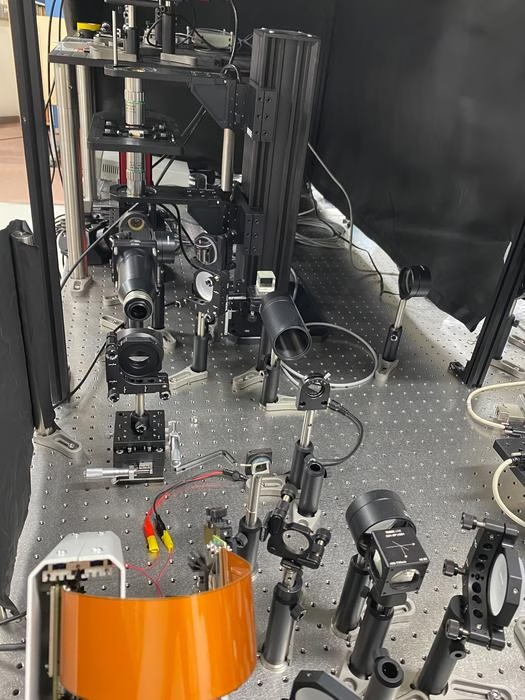
To tackle the speed-limiting weak point of OSH, he and his team constructed a setup that uses a high-speed “digital micromirror device” to project onto the object the patterns that are required for recording the hologram.
“This device operates at 22 kHz, whereas previously used devices have a refresh rate of 60 Hz. This is a speed difference that’s equivalent to the difference between an old person taking a relaxed stroll and a Japanese bullet train,” Yoneda explains.
In the journal Optics Express, the Kobe University team now publish the results of their proof-of-concept experiments.
They show that their setup can not only record 3D images of moving objects, but they could also construct a microscope that can record a holographic movie through a light-scattering object — a mouse skull to be precise.
Admittedly, the frame rate of just over one frame per second was still fairly low. But Yoneda and his team showed in calculations that they could in theory get that frame rate up to 30 Hz, which is a standard screen frame rate.
This would be achieved through a compression technique called “sparse sampling,” which works by not recording every portion of the picture all the time.
So, where will we be able to see such a hologram?
Yoneda says: “We expect this to be applied to minimally invasive, three-dimensional biological observation, because it can visualize objects moving behind a scattering medium.
But there are still obstacles to overcome.
We need to increase the number of sampling points, and also the image quality.
For that, we are now trying to optimize the patterns we project onto the samples and to use deep-learning algorithms for transforming the raw data into an image.”
This research was funded by the Kawanishi Memorial ShinMaywa Education Foundation, the Japan Society for the Promotion of Science (grants 20H05886, 23K13680), the Agencia Estatal de Investigación (grant PID2022-142907OB-I00) and the European Regional Development Fund, and the Generalitat Valenciana (grant CIPROM/2023/44).
It was conducted in collaboration with researchers from Universitat Jaume I.
More info
You may also be curious about:
-

‘Space archaeology’ reveals first dynamic history of a giant spiral galaxy
-

Thousands of pico-satellites may transform how phones connect to space
-

Barcelona’s Low Emission Zone reduces NO₂ levels
-
Neuroadaptive VR treatment for arachnophobia
-

The freshwater hidden beneath the Great Salt Lake
-

Moby Dick ‘ship sinking’ sperm whales caught headbutting on camera
-

Changing shower and toilet habits could help close England’s 5 billion litre water gap, Surrey-led research finds
-

Is your brain aging faster than you are? Sleep may hold the key
-
Initial tests find lead in children’s fast-fashion clothing
-
Aquatic plant reduces antibiotics in water and genetic damage in fish
-

When the Earth moved
-

Turning sawdust into fire-resistant, eco-friendly materials using watermelon seeds