
Researchers at Macquarie University in Australia are developing light-based methods to disrupt shark vision by breaking up silhouettes, aiming to prevent future shark attacks.
From Macquarie University 30/11/24 (first released 11/11/24)
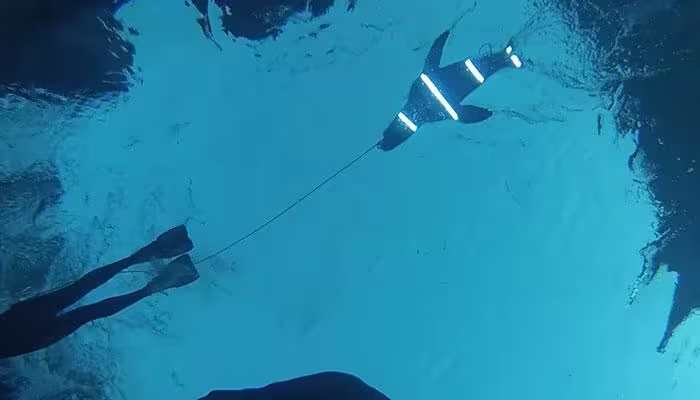
Surfers could be protected from future shark attacks following new discoveries about how to trick sharks’ visual systems made by Professor Nathan Hart, head of Macquarie University’s Neurobiology Lab, Dr Laura Ryan and colleagues.
Hart, Ryan and their co-authors of a new paper in Current Biology titled Counterillumination reduces bites by Great White Sharks say their work “may form the basis of new non-invasive shark deterrent technology to protect human life”.
These researchers previously discovered that great whites place a high reliance on their eyes to locate prey, lunge upwards to take potential food such as a seal in their jaws.
In related studies, researchers have found that great whites are likely completely colour blind with poor visual acuity, compensated by their strong ability to detect a silhouette.
But the shark’s poor vision means they can’t distinguish the silhouette of a surfboard or a human in the water from a seal, leading great whites to pose a danger to people.
The researchers took inspiration from juvenile plainfin midshipman fish which have photospores on its underside that produce light and disrupt the shape of its silhouette.
They trialled a method to disguise silhouettes on the water surface using lights so that the shark would not see them as food.
To test this out this counterillumination strategy Dr Ryan took multiple trips over six years, in notorious great white shark hot spot, Mossel Bay in South Africa.
The researchers towed 1.2m long, seal-shaped foam decoys on a 20m line behind a boat to attract sharks to attack.
Then they used LED lights, in different configurations, to break up the silhouette of the decoys.
They found lights placed in stripes across the bodies of the seal decoys perpendicular to their movement were an effective deterrent.
“It’s sort of like an invisibility cloak but with the exception that we are splitting the object, the visual silhouette, into smaller bits,” says Professor Hart.
“It’s a complex interaction with the shark’s behaviour.
The lights have to be a certain pattern, a certain brightness.”
More info
You may also be curious about:
-

‘Space archaeology’ reveals first dynamic history of a giant spiral galaxy
-
Thousands of pico-satellites may transform how phones connect to space
-

Barcelona’s Low Emission Zone reduces NO₂ levels
-
Neuroadaptive VR treatment for arachnophobia
-

The freshwater hidden beneath the Great Salt Lake
-
Moby Dick ‘ship sinking’ sperm whales caught headbutting on camera
-

Changing shower and toilet habits could help close England’s 5 billion litre water gap, Surrey-led research finds
-

Is your brain aging faster than you are? Sleep may hold the key
-

Initial tests find lead in children’s fast-fashion clothing
-
Aquatic plant reduces antibiotics in water and genetic damage in fish
-

When the Earth moved
-

Turning sawdust into fire-resistant, eco-friendly materials using watermelon seeds