
AI learns to build simple equations for complex systems

Duke University researchers develop AI that simplifies complex dynamics, revealing hidden variables for accurate predictions.
Who watches the AI watchman?

University of Waterloo researchers develop AI verification methods ensuring safe operation of autonomous vehicles and power grids.
New 3D printing method ‘grows’ ultra-strong materials

EPFL researchers develop innovative technique using hydrogels, achieving unprecedented density and strength in metal and ceramic structures.
Scientists find curvy answer to harnessing “swarm intelligence”

Radboud University researchers develop geometric rules to control robotic swarms, inspired by natural flocking behaviours.
Unprecedented optical clock network lays groundwork for redefining the second
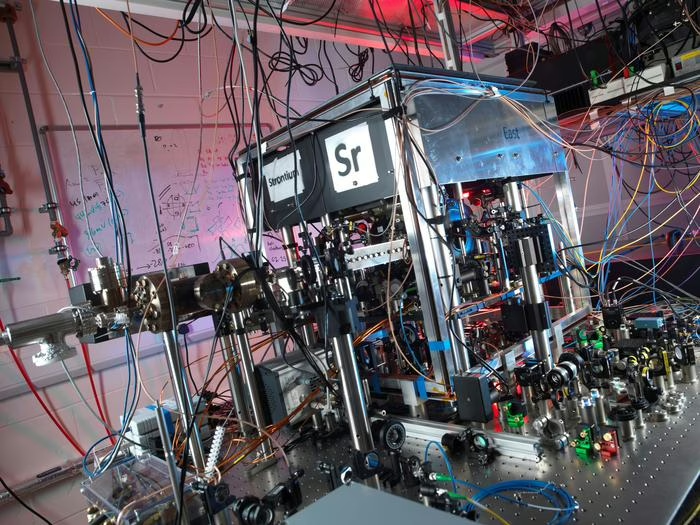
Researchers from the University of Oxford demonstrate enhanced precision, linking optical clocks across six European countries.
AI paves the way towards green cement

Researchers at Paul Scherrer Institute develop AI model reducing cement emissions by optimising formulations for sustainability.
Dark matter formed when fast particles slowed down and got heavy, new theory says

Dartmouth University researchers propose dark matter originated from high-energy particles condensing, impacting cosmic microwave background.
Mathematician solves algebra’s oldest problem using intriguing new number sequences

A UNSW Sydney mathematician discovers innovative sequences, providing fresh insights into solving complex higher polynomial equations.
Mathematicians identify optimum hula hooping

Scientists at New York University reveal how body shape and motion influence hula hoop performance, offering potential benefits for energy generation and robotics.
It’s not to be. Universe too short for Shakespeare typing monkeys

Mathematicians at the University of Technology Sydney in Australia have determined that monkeys typing Shakespeare is implausible due to the universe’s finite lifespan.